
Customer Retention Strategies With AI: How Business Owners Keep Customers Coming Back
Short answer: most small businesses use AI to write messages. The bigger win for customer retention is letting AI decide who to bring back, when to reach them and what to offer, based on each customer’s own visit pattern. Start by recording visits, then let the AI flag regulars who are slipping and send a personal WhatsApp before they are gone.
Most owners use AI for the wrong job
Ask a café or salon owner how they use AI and the answer is usually the same: captions, menu descriptions, a friendlier version of an offer. That saves a few minutes. It does not bring anyone back.
Writing was never the hard part of keeping customers. The hard part is knowing that Omar, who came every Friday, has missed three Fridays, and doing something about it this week instead of next month. That is a decision, and deciding is where AI earns its place.
How AI changes customer retention strategies: four levels
| Level | What AI does | Example at a café | Impact on retention |
|---|---|---|---|
| 1. Write | Drafts messages and offers | “Write a birthday message for our regulars” | Low: you still decide who gets it and when |
| 2. Sort | Groups customers by what they actually do | New, regulars, going quiet, lost, top customers | Medium: the right message reaches the right group |
| 3. Decide | Picks who to contact, when and with what | Maya is 11 days late on her usual visit: send a nudge today | High: you act before a regular is gone |
| 4. Learn | Notices what brings people back and does more of it | A free pastry brings back quiet regulars better than 10% off | High, and it grows over time |
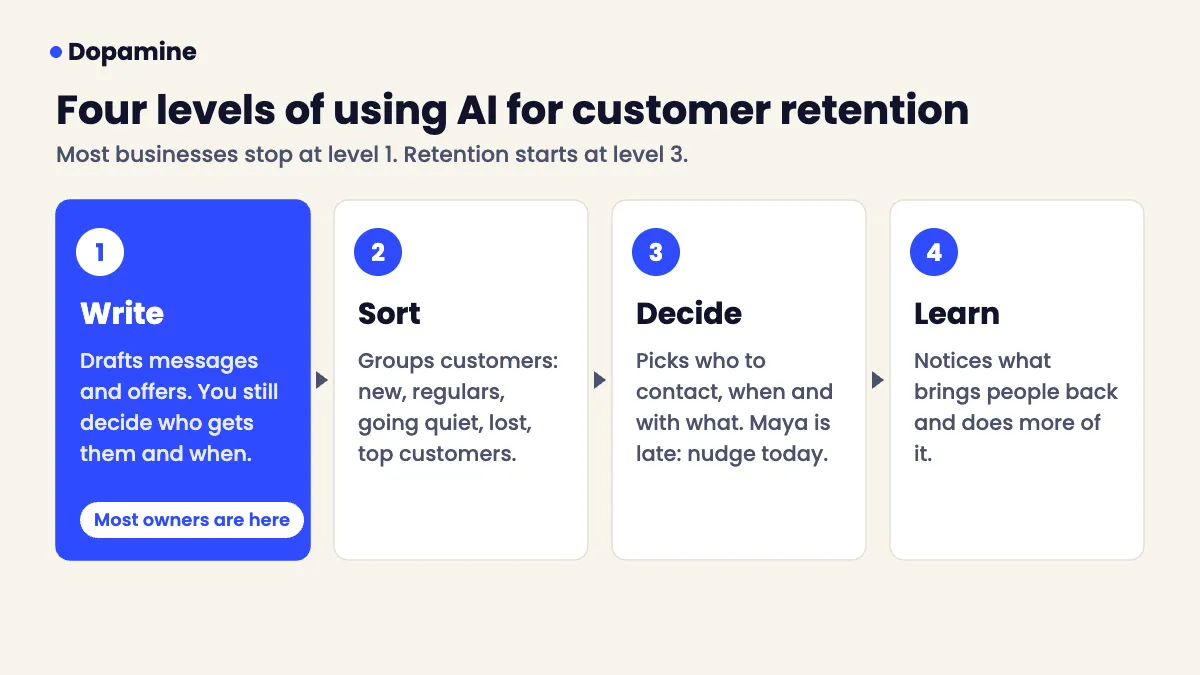
Most businesses stop at level 1. The five strategies below take you to levels 3 and 4 without a data team.
How to retain customers with AI: 5 strategies
Strategy 1: Record every visit, not just every sale
AI can only spot a pattern it can see. A till shows sales; it does not show that the same person bought them. Before anything clever, you need each visit tied to a customer: who came, when, and what they spent.
The simplest way for a walk in business is a loyalty program customers actually join. A QR code on the counter that opens WhatsApp gets more people in than an app download, and every stamp becomes a recorded visit.
Strategy 2: Swap fixed reminders for each customer’s rhythm
The old way is one rule for everyone: “message anyone who has not visited in 30 days”. It is too late for the daily coffee regular and too early for the client who books every six weeks.
Every regular has a rhythm. Maya comes every 8 days, Omar every second Friday, Sarah every six weeks for a colour. AI can learn each rhythm and flag the moment one breaks. Maya at day 19 is a warning sign. Sarah at day 19 is right on schedule.
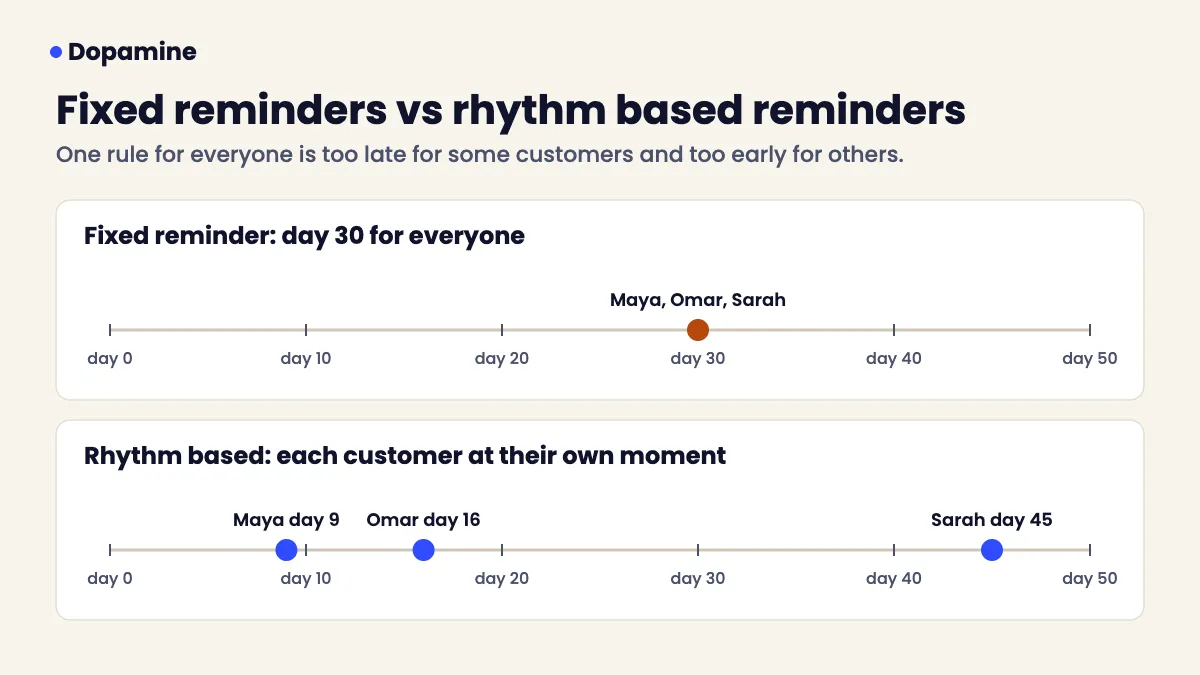
Strategy 3: Decide who needs what (not everyone needs a discount)
Sending the same 20% off to every customer trains your best regulars to wait for offers and wastes margin on people who were coming anyway. Use AI to match the action to the customer:
| Customer situation | Best action |
|---|---|
| Has a free reward waiting they never used | A reminder, no new offer needed |
| One stamp away from a reward | A nudge: “one more visit and it’s yours” |
| Regular who is overdue | A personal win back message, with a small treat if they stay quiet |
| Top customer visiting less often | Recognition: a thank you and a gift, not a coupon |
| Happy, regular, on rhythm | Leave them alone |
Some customers want to be recognised, some need a nudge, and only a few need money off.
Strategy 4: Reach them where they actually read
Email open rates for small businesses are often low, and many customers ignore promotional texts. Most people in the UAE, India, the UK and much of the world check WhatsApp many times a day. For walk in businesses, a short personal WhatsApp from the place they already visit is usually the channel that gets seen.
Keep it human: their name, the thing they usually order, one clear reason to come back, and only to customers who joined and agreed to hear from you.
Strategy 5: Let it learn what works
Every message is a small test. Did the free pastry bring Omar back? Did the rebook reminder at week five work better than at week six? A good AI system keeps score and leans towards what works for your customers, so the program gets sharper the longer it runs. Your job is to check the numbers once a week: how many came back, and which offer did it.
Is your business ready? A quick checklist
| Check | Yes / No | If no |
|---|---|---|
| Each visit is linked to a customer | ☐ / ☐ | Start a WhatsApp or digital loyalty program |
| You can see new, returning and lost customers each month | ☐ / ☐ | Track your customer retention rate |
| You know who your top 20 customers are | ☐ / ☐ | Sort customers by visits and spend |
| You can message customers who agreed to hear from you | ☐ / ☐ | Collect consent when they join |
| Someone looks at the results every week | ☐ / ☐ | Put 15 minutes in the diary every Monday |
Four or five yes answers: you are ready for AI to start deciding. Fewer: start with strategies 1 and 2. A few weeks of visit data is enough to begin.
What AI cannot do for retention
- It cannot fix a bad product, slow service or a rude welcome.
- It only knows what you record. No visit data, no useful predictions.
- It should never message people who did not agree to it.
- It does not replace remembering a regular’s name when they walk back in.
How Dopamine does this
Dopamine is a WhatsApp loyalty program with an AI retention agent built in. Customers join by scanning a QR code, staff record each visit with a short code and the bill, and the agent learns each customer’s visit rhythm. It then suggests one tap actions: remind customers with an unused reward, nudge those one stamp away, win back overdue regulars, and send a treat to top customers who are visiting less, with the money at stake shown for each. On autopilot it handles rebook nudges, birthday treats, win back offers and Google review requests. Read more about the AI retention agent.
Dopamine is free to start on the Ignite plan. WhatsApp messages cost USD 0.065 each (minimum 100). See pricing.
Related guides
- What is an AI retention agent?
- Customer churn: spot regulars slipping away
- AI agents for small business
- WhatsApp loyalty program: the complete guide
Frequently asked questions
What are the best customer retention strategies for a small business?
Record every visit, follow each customer’s visit rhythm, match the action to the customer instead of discounting everyone, message them on WhatsApp and keep what works. AI can spot which customers are slipping away, decide who needs a reminder, a nudge or a treat, and send it at the right moment on the channel they read, then learn which offers bring people back.
What data do I need to use AI for customer retention?
Each visit linked to a customer: who came, when and what they spent. A loyalty program where customers join by QR code on WhatsApp collects this automatically. A few weeks of visits is enough to start.
Is AI for customer retention only for big brands?
No. Small cafés, salons and shops can use it once visits are recorded. The tools now run on WhatsApp and need no data team.
Should AI send everyone a discount?
No. Most customers respond to a reminder, a nudge or recognition. Keep discounts for overdue regulars who stay quiet.
How much does AI customer retention software cost?
Dopamine starts free on the Ignite plan. WhatsApp messages cost USD 0.065 each (minimum 100).